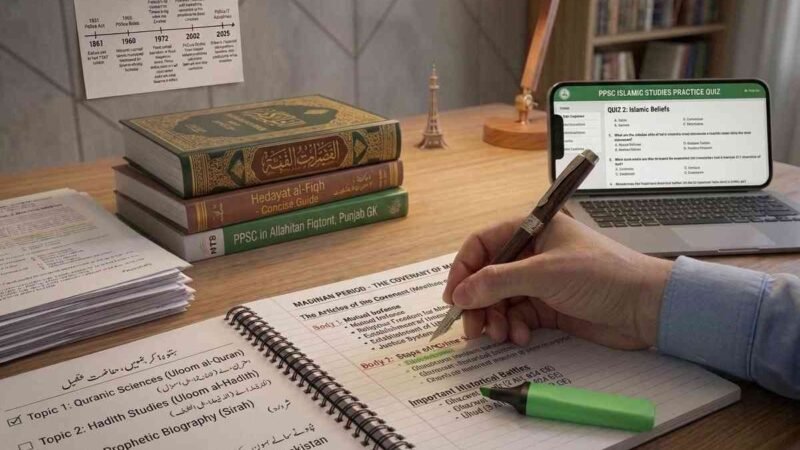
Islamic Studies MCQs with Answers for CSS & PPSC
Islamic Studies is a compulsory and highly scoreable portion in CSS, PPSC, FPSC, and NTS exams. Its questions rest on established knowledge of the Quran, Seerat, Hadith, and the fundamentals of Islam, which means dedicated preparation reliably converts into marks. This guide outlines the core topics and the most effective way to practice.
Why Islamic Studies is a reliable scoring area
Because the subject is built on settled religious knowledge, its facts do not change from one exam to the next. Once you learn the pillars of Islam, key events of the Seerat, and the basics of the Quran and Hadith, that knowledge stays dependable across every test you take. This stability makes Islamic Studies one of the safest sections to prepare thoroughly.
Core topics to cover
- The Quran: revelation, major surahs, and basic themes.
- Seerat of the Prophet: key events, battles, and their significance.
- Pillars and beliefs: the five pillars and articles of faith.
- Hadith and its sciences: major collections and their compilers.
- Islamic history: the rightly guided caliphs and early Islam.
Questions on the pillars of Islam, the Seerat, and the Quran appear repeatedly in past papers, so give these areas priority.
How the questions are set
Islamic Studies MCQs are usually direct and factual, testing dates, names, events, and definitions. The main challenge is the volume of specific details, which are easy to mix up under exam pressure. Repeated testing is the surest way to make the correct answers automatic.
Practice with instant feedback
Reading through notes once rarely secures a fact-heavy subject like this. Active recall does. Our interactive MCQ test series lets you attempt topic-wise Islamic Studies questions, check the correct answer instantly, and progress from Easy to Hard as your confidence grows. Every attempt reinforces the details examiners test.
Build a steady revision plan
Divide the subject into themes and rotate through them across the week, ending each session with a short quiz. Keep a list of the questions you miss and revisit it every few days. This spaced repetition embeds the facts far more effectively than a single long reading session.
Islamic Studies pairs well with the other compulsory portions. Strengthen your overall preparation with our Pakistan Affairs MCQs and General Knowledge MCQs guides, and find complete commission papers in our past papers hub.
Common mistakes to avoid
Many candidates read the material passively and never test themselves, so details slip away under pressure. Others focus on a single topic and neglect the rest. Balanced, tested revision across all core areas fixes both problems and steadies your score.
How many questions to expect
Islamic Studies usually contributes a dependable block of objective marks, and because the knowledge is settled, thorough preparation converts reliably into a strong score. The main challenge is the volume of specific names, dates, and events, which repeated testing makes automatic. Answer confidently and keep your pace steady.
Frequently asked questions
Which areas should I focus on first?
The pillars of Islam, the Seerat of the Prophet, and the basics of the Quran appear most often in past papers. Master these before moving to Hadith sciences and early Islamic history.
How do I remember so many details?
Use active recall. Attempting questions repeatedly embeds names and dates far better than re-reading notes, and it prepares you for the pressure of the real exam.
Is the practice test free?
Yes. Our Islamic Studies test is free and topic-wise, with instant answers after every question.
Let past papers direct your effort
Islamic Studies covers a great deal of material, so working smart matters as much as working hard. Past papers show you which topics carry the most weight, from the pillars of Islam to the key events of the Seerat, so you can concentrate your revision where the marks are densest. Reviewing several years of questions quickly reveals the details examiners favour.
Turn that insight into a routine: study a theme, attempt a set of questions on it the same day, and revisit every miss across the week. This steady loop of learning and testing embeds names, dates, and events far more reliably than reading alone. Complete commission papers are available in our past papers hub to support your practice.
Do I need to know Arabic to prepare?
No. The objective portion tests facts about the Quran, Seerat, and Islamic history in English, so a strong grasp of the core events, names, and concepts is enough. Focus your effort on understanding and remembering these details through regular testing.
Start your Islamic Studies practice
Islamic Studies rewards careful, consistent preparation. Learn the core facts, test yourself often, and revise your mistakes. Open the Islamic Studies test now, attempt your first set today, and turn this compulsory portion into one of your most dependable scoring areas. With settled facts and steady, tested revision, Islamic Studies can become one of the surest sources of marks on your entire paper.